China's RoboParty Launches Open-Source Humanoid Robot RP1
RoboParty has launched the RP1, a full-stack open-source humanoid robot designed for robotics research and embodied AI development, offering access to both hardware and software.
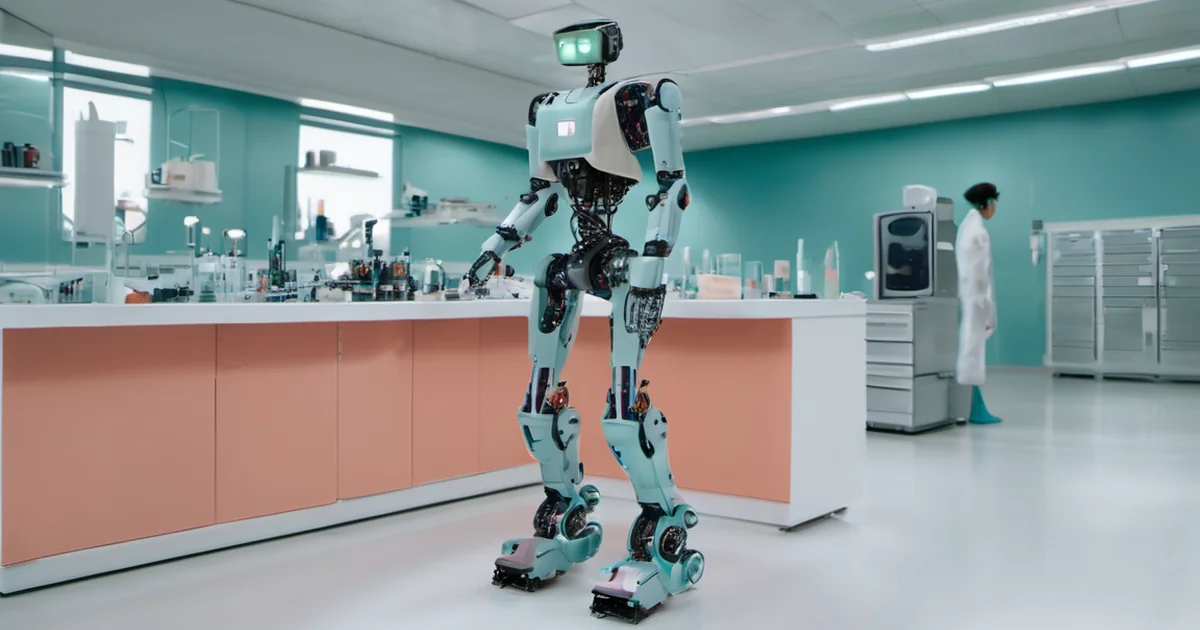
RP1's Open-Source Hardware and Software Features
China's RoboParty has launched the RP1, a full-stack open-source humanoid robot designed for robotics research and embodied AI development. The RP1 provides access to both hardware and software, allowing researchers to modify the robot’s mechanical design, actuators, control systems, and software rather than working through a closed interface. The platform supports both standard and Pro versions, with 24 and 30 actuated degrees of freedom, respectively, and includes features such as modular hardware, whole-body control, VR teleoperation, motion capture, and simulation-to-real-world workflows. Technical resources for RoboParty’s ROMOMO joint actuators, low-level drivers, control algorithms, firmware, simulation tools, software development kits, and robot-learning frameworks are available to facilitate system-wide failure tracing. RP1 extends RoboParty’s RPO open-source project and is accessible through GitHub.
RP1 Configurations and Modular Design
The RP1 humanoid robot offers multiple configurations to support diverse research applications. The standard RP1 model stands approximately 1.3 meters tall and features 24 actuated degrees of freedom (DoF), enabling studies in gait, balance control, and sim-to-real transfer . The Pro version expands this to 30 DoF, including a two-degree-of-freedom neck and two seven-degree-of-freedom arms, facilitating research into end-to-end policies, human-robot interaction, and data collection for embodied AI . The robot’s modular design allows for interchangeable head modules and wrist end effectors, such as the RP Hand dexterous hand . Additionally, the RP1 supports a range of research tools, including virtual-reality teleoperation, motion capture, data collection and playback, motion retargeting, and whole-body control . This adaptability ensures the platform can be tailored to meet the specific experimental needs of research teams .
Integration with RoboParty's Ecosystem and Research Tools
The RP1 humanoid robot is designed to integrate seamlessly with RoboParty’s broader ecosystem, including its PartyOS embodied AI system, UFO reinforcement-learning framework, and MimicLite motion-imitation technology, as noted by RoboParty (theaiinsider.tech). This integration enables researchers to perform motor skill learning, control policy development, and higher-level applications (engineering.com). An open toolchain supports data collection, simulation training, deployment on physical robots, and experimental validation (engineering.com). RoboParty has also emphasized consistency in the robot’s mechanical structure, actuators, and manufacturing process to minimize hardware variation as a source of experimental differences (theaiinsider.tech). The RP1 continues RoboParty’s open-source approach by incorporating ROMOMO joint actuator modules, research from the RoboParty Lab, and ongoing PartyOS development to strengthen the technology foundation for robotics research and embodied AI model development (engineering.com).
RPO Open-Source Project and Community Engagement
RoboParty’s RPO open-source project, launched in January 2026, provides mechanical and electrical design resources, along with training and deployment materials for the RP1 humanoid robot (theaiinsider.tech). The project has gained significant traction, with over 2,600 stars on GitHub (theaiinsider.tech). RoboParty aims to build a shared foundation for global innovation by making the future of embodied AI accessible to all who wish to explore it (engineering.com). In a similar move, Amazon Web Services (AWS) recently introduced an open-source Physical AI Toolchain to assist roboticists in training, simulating, and deploying AI models on robots (therobotreport.com). This toolchain is open source, allowing startups and larger companies to use and modify it (therobotreport.com).
Broader Context of Open-Source Robotics and AI Toolchains
Open-source robotics has gained momentum as a means to accelerate innovation in humanoid systems, with initiatives like China's RoboParty emphasizing full-stack open source across both hardware and software, as noted in engineering.com. This approach allows developers to understand, modify, and validate the physical systems that underpin intelligent behavior, as highlighted in engineering.com. While the Physical AI Toolchain offers a range of capabilities, it is not a direct replacement for RoboMaker, a cloud-based robotics simulation platform that was shut down in 2025, according to therobotreport.com. Companies can leverage toolchains to collect demonstrations, generate synthetic training scenarios, and test models in simulation before deployment, as described in therobotreport.com. Contributions from NVIDIA, including Isaac Sim and Isaac Lab, further support this ecosystem, as stated in therobotreport.com. Although the Toolchain is not a tactile-sensing platform, its support for diverse data sources and edge deployment could enable integration of specialized sensing, as noted in therobotreport.com.
Sources and reporting notes
Based on published source material. No independent hands-on testing is claimed.



