AI Trains Virtual Robot to Navigate and Identify Objects
A virtual robot trained with AI models, including GPT-6 Sol and Nvidia Isaac Sim, learned to navigate and identify Bengal cats in a few hours using 3D simulations and agentic harnesses.
Training a Virtual Robot with AI Models
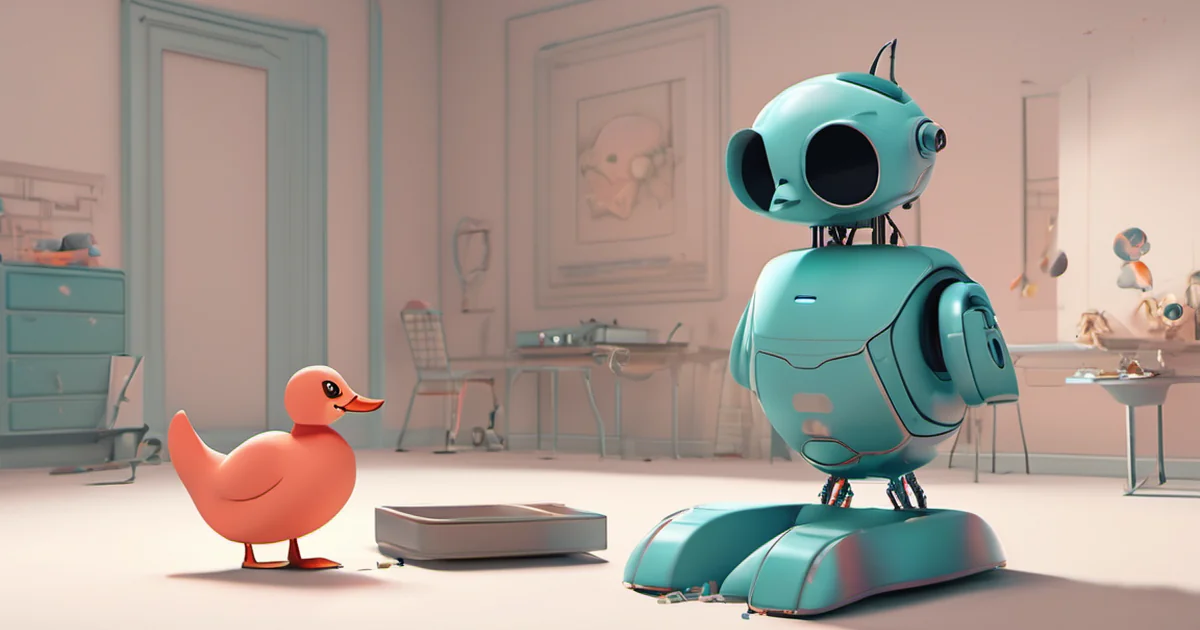
Training a virtual robot with AI models has become increasingly accessible, as demonstrated by a recent experiment involving a virtual version of Microduck, a robot developed by Pollen Robotics and Hugging Face. Using OpenAI’s GPT-6 Sol, the virtual robot was taught to navigate a room and identify Bengal cats in its environment. According to the experiment, this process was completed in just a few hours, a feat attributed to the advanced capabilities of GPT-6 Sol in understanding and manipulating 3D representations of the physical world. The training also involved an agentic harness from Nous Research called Hermes and a Nvidia DGX Spark, a powerful AI chip-based personal computer. Nvidia’s Isaac Sim software was used to provide instructions to the model, monitor the robot’s performance through video, and suggest improvements to its training. As noted, such tasks typically require significant expertise, but modern coding models have made the process much more straightforward.
Challenges in Simulating Real-World Behavior
At the Conference on Robot Learning (CoRL), held in Austin, Texas, this week, Fan gave a keynote speech in which he talked about the incredible realization that AI models can automate a lot of the work needed to have a robot do sophisticated things. One example: GPT-6 Astra figured out how to use a pair of robot arms to solve a Rubik’s cube. “Then it reasons for a very, very long time, but it eventually is able to solve it because it learns the skills over time.” However, challenges remain. I initially tried getting GPT-6 Sol to teach the robot to moonwalk—I fed it a GIF of Michael Jackson sliding across the stage, which it tried to copy—but after hours of effort, it only resulted in a very jaunty backward jog. The vision system on my robot duck does not work well enough to be deployed in a real product.
Potential Impact on Robotics and Automation
The potential impact of AI-driven robotics on manufacturing and e-commerce is significant, as noted by Goldberg, who highlights the growing interest from industrial robotics and automation firms in this approach . The ease and speed of training robots with AI could revolutionize these sectors. Similarly, the concept of “vibe robotics” may emerge, much like “vibe coding” did in the past, as hobbyists and engineers discover how straightforward it is to program and train robots . This shift could democratize robotics development, enabling more people to contribute to innovation. As demonstrated in the training of the virtual Microduck, AI can rapidly generate detailed 3D simulations with precise parameters . These advancements may lead to more accessible and adaptable robotic systems in the future.
Sources and reporting notes
Based on published source material. No independent hands-on testing is claimed.



